In the modern SEO landscape, the days of "one keyword per page" are long gone. Google's algorithms have evolved to understand semantic meaning and user intent. If you are still manually sorting spreadsheets with thousands of keywords, you are not just wasting time—you are falling behind.

Ready to automate your SEO? Try our free AI Keyword Clusterer to group your keywords in seconds using Groq-powered inference.
Automate Your Keyword Research
Stop sorting spreadsheets manually. Try our Free AI Keyword Clusterer to group thousands of keywords by search intent in under 100ms.
The Shift: From Strings to Things
Google’s transition from "strings" to "things" means it no longer looks at keywords as isolated text fragments. Instead, it views them as concepts. For example, if a user searches for "best marathon training plan" and "how to run a marathon for beginners," Google understands these belong to the same semantic cluster.
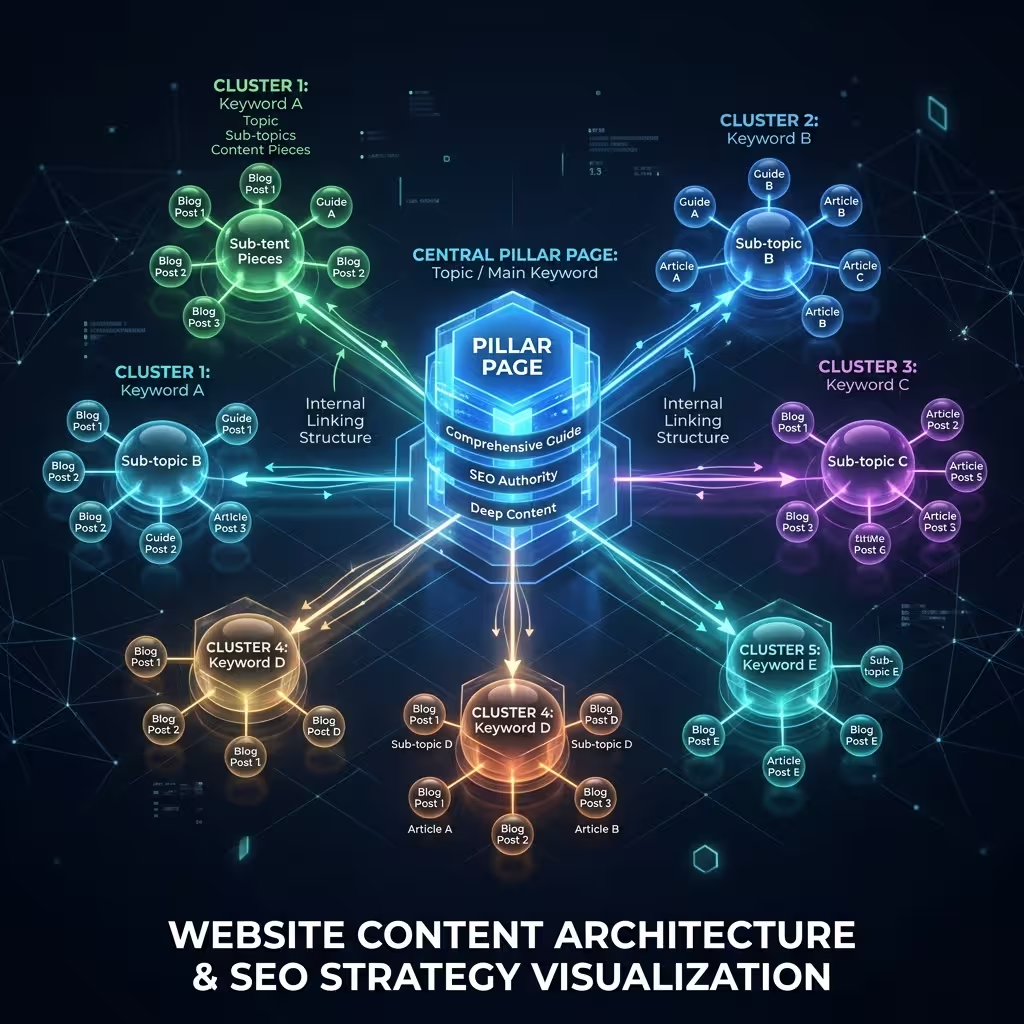
Grouping these keywords allows you to create "Pillar Pages" and "Cluster Content," a strategy known as Topical Authority. By covering an entire topic comprehensively rather than targeting individual keywords, you signal to search engines that you are an expert in your niche.
The 1,000 Keyword Challenge
When you perform a standard keyword export from tools like Ahrefs or SEMrush, you often end up with a list of 500, 1,000, or even 10,000 keywords. Sorting these manually involves:
- Identifying duplicate intents.
- Categorizing by funnel stage (Informational vs. Transactional).
- Mapping keywords to existing or new URLs.
- Estimating the total potential volume for each cluster.
For 1,000 keywords, this process can take a professional SEO specialist anywhere from 4 to 8 hours. With AI, it takes less than 30 seconds.
Step-by-Step: How to Group 1,000 Keywords with AI
Step 1: Export Your Raw Data
Go to your keyword research tool of choice. Export a list of keywords related to your seed topic. Ensure you include columns for Search Volume and Keyword Difficulty (KD) if available.
Step 2: Paste into the AI Clusterer
Open the Innovate Beacon Keyword Clusterer. You can paste the raw keywords directly, or even better, paste the entire data block including Volume and KD. Our tool is smart enough to parse the data automatically.
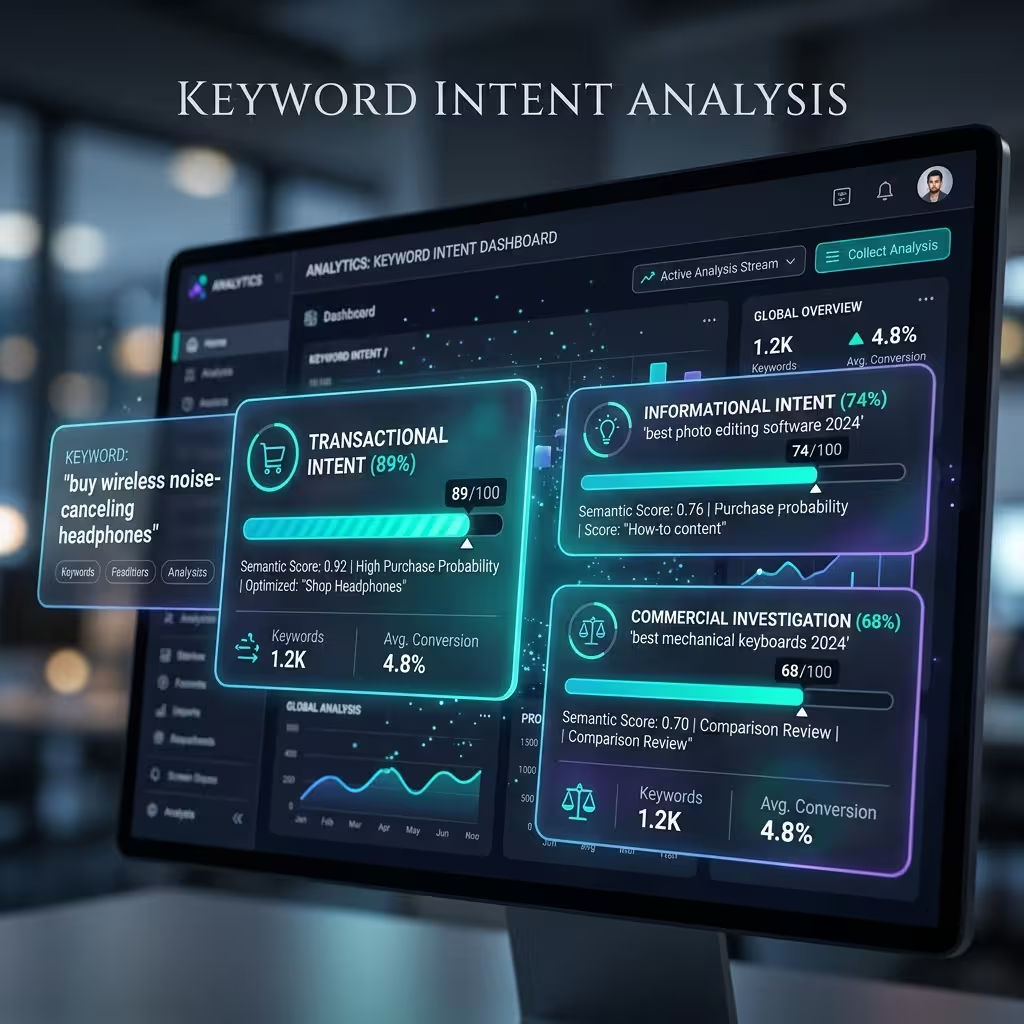
Step 3: Analyze Intent Labels
Once you click "Generate Clusters," the AI will categorize every keyword. It will look for patterns like:
- Informational: Users looking for answers ("how to," "what is").
- Commercial: Users researching options ("best," "top," "vs").
- Transactional: Users ready to buy ("buy," "discount," "pricing").
Step 4: Build Your Silo Map
The output will be grouped into "Cards." Each card represents a potential blog post or landing page. Use these groups to build your Silo Structure.
How Teams Use Clustering to Save 5+ Hours on SEO
In the fast-paced US and UK digital markets, efficiency is the only way to scale. Traditional keyword research often leads to "analysis paralysis," where SEO managers spend days staring at spreadsheets without a clear action plan.
By using automated semantic grouping, professional teams are now:
- Reducing Content Waste: Identifying keyword overlaps before the writing phase to avoid duplicate content.
- Accelerating Content Briefs: Generating entire content calendars from a single master keyword list in minutes.
- Improving AdSense ROI: Higher topical relevance leads to better ad placements and higher CPC from Tier 1 traffic.
If you're also focused on data security and compliance while scaling your SEO, check out our TOS Red Flagger tool, which helps teams stay safe by instantly identifying legal risks in vendor agreements.
Why This Strategy Wins in 2026
Search engines are increasingly using Zero-Shot Classification to understand content. When you group keywords semantically, you are essentially "pre-packaging" your content in a way that search engines find easy to index. This leads to:
- Faster Indexing: Clear site architecture helps bots crawl more efficiently.
- Higher Rankings for Long-Tail Keywords: One comprehensive post can rank for hundreds of variations.
- Better User Experience: Users find exactly what they need within a logical content flow.
Automate Your Content Roadmap
Stop guessing what to write next. Use our AI Keyword Clusterer to turn a messy list of keywords into a professional 6-month content strategy today.
Group Keywords NowFrequently Asked Questions
What is keyword clustering?
Keyword clustering is the process of grouping keywords with similar search intent into a single topical silo to help search engines understand the breadth of your content.
How long does it take to group 1,000 keywords?
Manually, it can take 4-8 hours. Using our AI Keyword Clusterer, it takes less than 30 seconds.
Why should I use AI for keyword clustering?
AI can analyze the semantic embedding distance between keywords much faster and more accurately than a human, ensuring your content silos are perfectly aligned with Google's intent-based algorithms.
Does keyword clustering help with rankings?
Yes, by organizing your content into semantic clusters, you build topical authority, which signals to Google that you are a comprehensive expert on the subject, leading to higher rankings.