
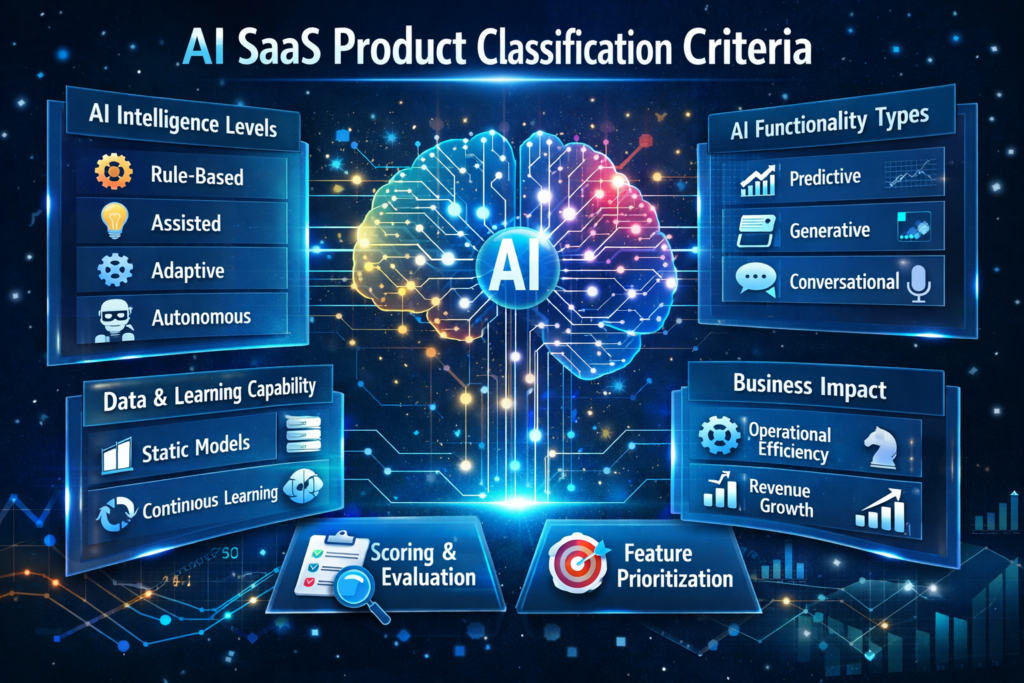
Choosing the right AI-powered software is no longer about flashy features or marketing buzzwords. In today’s crowded SaaS ecosystem, success depends on understanding AI SaaS product classification criteria—a structured way to evaluate how intelligent, how useful, and how valuable an AI SaaS product truly is.
Too many buyers still ask the wrong question:
“Does this product use AI?”
The smarter question is:
“How does this AI actually work, and what impact does it create for my business?”
This guide breaks down AI SaaS product classification criteria in a simple, human way—so founders, buyers, marketers, and investors can make confident, data-backed decisions.
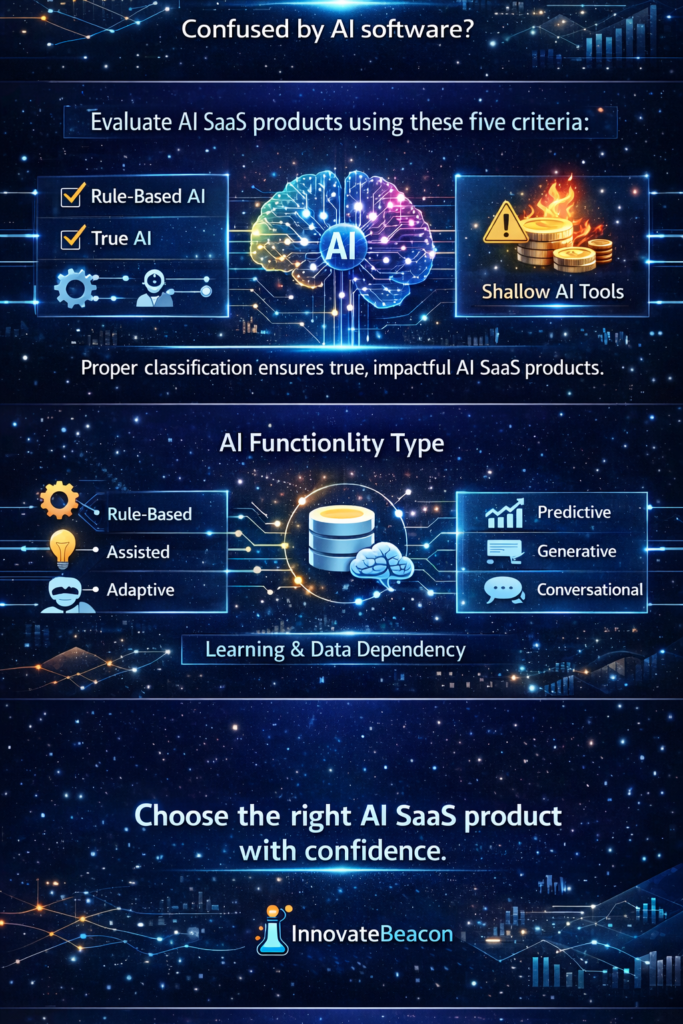
What Are AI SaaS Product Classification Criteria?
AI SaaS product classification criteria refer to the standards used to categorize AI-based SaaS products according to their intelligence level, learning capability, functionality, user control, and business impact.
Instead of treating all AI tools the same, classification helps you understand:
- How deeply AI is embedded
- What type of AI functionality is used
- Whether the system learns and adapts
- How decisions are made and controlled
- What measurable value the product delivers
📌 Background reading:
https://en.wikipedia.org/wiki/Artificial_intelligence
https://en.wikipedia.org/wiki/Software_as_a_service
Why AI SaaS Product Classification Criteria Matter in 2026
As AI adoption grows, misleading AI claims have become common. Many tools marketed as “AI-powered” rely on rule-based automation, not true machine learning.
Understanding AI SaaS product classification criteria helps you:
- Avoid shallow or fake AI products
- Compare competing SaaS tools objectively
- Align AI capabilities with real business goals
- Reduce onboarding and implementation risks
- Increase ROI and long-term trust
Industry analysts like Gartner repeatedly emphasize that transparent AI capabilities are now a key buying factor.
📖 Reference:
https://www.gartner.com/en/information-technology/insights/artificial-intelligence
A Short Anecdote: Classification in Action
A marketing agency once invested in an “AI-driven analytics platform.” On the surface, it looked powerful.
But after closer inspection, the product:
- didn’t learn from new data,
- offered no predictive insights,
- and relied on static dashboards.
Using AI SaaS product classification criteria, the agency reclassified the tool as assisted intelligence, not adaptive AI. They switched platforms—and improved campaign ROI by 41% within one quarter.
Core Foundations of AI SaaS Product Classification Criteria
Before diving deeper, every AI SaaS product should be evaluated on five foundational dimensions:
- Level of AI intelligence
- Type of AI functionality
- Learning and data dependency
- Human control and interaction
- Business impact and scalability
These fundamentals power the advanced classification models discussed below.
AI SaaS Product Segmentation Based on Intelligence Level
AI SaaS product segmentation groups tools by how intelligent their AI systems actually are.
Rule-Based Automation
- Uses predefined “if-then” logic
- No learning or improvement over time
- Often mislabeled as AI
📘 Reference:
https://en.wikipedia.org/wiki/Rule-based_system
Assisted Intelligence
- AI suggests insights or recommendations
- Humans make final decisions
- Common in reporting and analytics tools
📘 Learn more:
https://www.ibm.com/topics/augmented-intelligence
Adaptive Intelligence
- Learns from user behavior and data
- Improves predictions continuously
- Used in personalization and recommendations
📘 Explanation:
https://www.sas.com/en_us/insights/analytics/machine-learning.html
Autonomous Intelligence
- Makes decisions independently
- Continuously self-optimizes
- Requires governance and monitoring
📘 Deep dive:
https://www.mckinsey.com/featured-insights/artificial-intelligence
SaaS Product Type Classification by AI Functionality
SaaS product type classification focuses on what the AI actually does, not how it’s marketed.
Predictive AI SaaS
Forecasts outcomes using historical data.
Common use cases:
- Sales forecasting
- Demand prediction
- Churn analysis
Generative AI SaaS
Creates new content such as text, images, or code.
Examples:
- AI writing tools
- Image generators
- Code assistants
📘 Overview:
https://www.ibm.com/topics/generative-ai
Widely used by platforms like OpenAI.
Prescriptive AI SaaS
Recommends specific actions to take next.
Examples:
- Dynamic pricing
- Workflow optimization
- Resource allocation
📘 Reference:
https://www.techtarget.com/searchenterpriseai/definition/prescriptive-analytics
Conversational AI SaaS
Uses natural language to interact with users.
Examples:
- Chatbots
- Virtual assistants
- Voice interfaces
📘 Guide:
https://cloud.google.com/learn/what-is-conversational-ai
SaaS Product Scoring Algorithm for Objective Evaluation
A SaaS product scoring algorithm assigns weighted scores to AI capabilities, helping buyers compare tools objectively.
Common Scoring Factors
- AI intelligence depth
- Learning capability
- Data usage
- User control
- Business impact
Each factor is scored, then combined into a final evaluation score.
📘 Related concept:
https://en.wikipedia.org/wiki/Decision_analysis
This approach is widely used by enterprise buyers and investors to reduce bias.
AI Product Feature Prioritization Using Classification Data
AI product feature prioritization ensures that the most valuable AI features are built, marketed, and improved first.
Classification data helps teams:
- Focus on high-impact AI features
- Remove low-value automation
- Align product roadmaps with customer needs
📘 Product prioritization framework:
https://www.productplan.com/glossary/product-prioritization/
This is why companies like Salesforce invest heavily in AI feature clarity and transparency.
📘 Resource:
https://www.salesforce.com/artificial-intelligence/
Step-by-Step Guide: How to Apply AI SaaS Product Classification Criteria
Step 1: Identify the AI’s Role
Is AI central to the product—or just an add-on?
Step 2: Segment the Intelligence Level
Rule-based, adaptive, or autonomous?
Step 3: Classify the SaaS Product Type
Predictive, generative, conversational, or prescriptive?
Step 4: Apply a SaaS Product Scoring Algorithm
Assign weighted scores to each criterion.
Step 5: Prioritize AI Features
Focus on features that drive measurable business value.
Why Proper Classification Increases Buyer Confidence
When buyers understand AI SaaS product classification criteria, they:
- Trust product claims
- Make faster decisions
- Reduce churn
- See higher ROI
Clear classification turns hesitation into confidence.
Final Editorial Takeaway
AI SaaS product classification criteria are no longer optional—they are essential.
In a market flooded with AI claims, the products that win are the ones that clearly define:
- their intelligence level
- their SaaS product type
- their scoring logic
- their feature priorities
That clarity builds trust—and trust drives sales.
FAQs
What are AI SaaS product classification criteria?
AI SaaS product classification criteria are structured standards used to evaluate and categorize AI-powered SaaS tools based on their intelligence level, learning capability, AI functionality, user control, and business impact. These criteria help buyers differentiate between true AI-driven products and basic automation tools, enabling smarter purchasing and investment decisions.
Why is AI SaaS product classification important for buyers?
Understanding AI SaaS product classification criteria helps buyers avoid misleading AI claims and choose software that delivers real value. It allows fair comparison between tools, reduces implementation risks, improves ROI, and builds confidence by clearly showing how the AI works, learns, and impacts business outcomes.
What is a SaaS product scoring algorithm and how is it used?
A SaaS product scoring algorithm assigns weighted scores to AI features such as intelligence depth, learning ability, data usage, and business impact. This objective scoring system helps organizations compare multiple AI SaaS products fairly, reduce bias, and select tools that deliver measurable, long-term value.
How does AI product feature prioritization benefit SaaS companies?
AI product feature prioritization ensures development teams focus on high-impact AI capabilities rather than low-value automation. By using classification data, SaaS companies can align features with customer needs, improve product-market fit, and communicate AI value more clearly—leading to higher adoption, retention, and revenue growth.
How does AI SaaS product segmentation improve decision-making?
AI SaaS product segmentation groups tools by intelligence level and AI maturity, making it easier to compare similar products. This segmentation helps buyers quickly identify whether a product offers rule-based automation, adaptive intelligence, or autonomous AI—ensuring the chosen solution aligns with business needs and technical readiness.